Holy Bible King James + Audio
- 4.8
- Rating
- 1.00M
- Installs
- Free
- Price
 Analysis by App-foxy
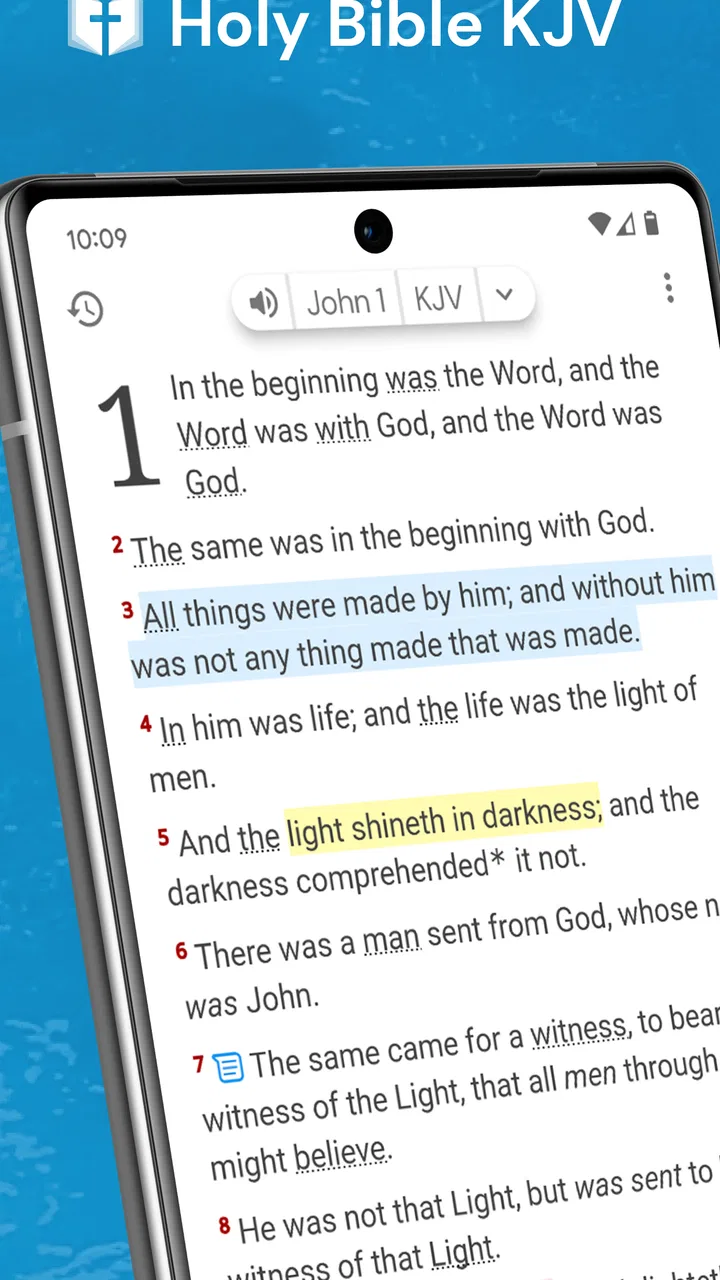
I approached Holy Bible King James + Audio as both a reading tool and a small daily study companion, rather than judging it only by its familiar title. It is a free Books & Reference app from Tecarta, Inc., built around the King James Bible, daily verse reading, dramatic audio, and Strong’s Concordance. That combination makes it more useful than a simple text viewer, especially if you want to move between reading, listening, and word study without changing apps.
My first impression was that its appeal depends heavily on what you want from a Bible app. If you already prefer the King James Version, the app gives you a focused way to keep that translation close at hand. If you are looking for modern language, broad comparative study, or a minimalist reader with no extra layers, the experience may feel less suitable. The app is free to install and rated for Everyone, but optional in-app purchases range from $0.99 to $299.99 per item, so I would still pay attention to what is offered before buying anything.
What makes the King James reading experience useful
The main strength is the way several related activities sit together. I can open a passage for ordinary reading, use the daily verse as a short entry point, switch to dramatic audio when reading is inconvenient, and consult Strong’s Concordance when a particular word deserves closer attention. These are not separate reasons to install it; they work best as a connected routine.
You May Also Like

 Blood Strike: 2.5 Anniversary
Blood Strike’s Loadouts Turn Every Drop Into a Tactical Gamble
A close look at Blood Strike’s custom loadouts: how fast access to signature weapons reshapes its battle royale rhythm, rewards preparation, and narrows the gap between fights.

 Pandora - Music & Podcasts
Pandora’s Music Is Easy to Start, but Harder to Recover
Pandora’s strength is its low-effort path from a seed to a station. Its weak spot is how much confidence it asks you to place in connection, setup, and quiet recovery.

 8 Ball Pool
 Is Built on Rivalries, Rematches, and Routine
A close look at the rivalries, rematches, shared routines, and unanswered safety questions that turn a quick pool match into a persistent mobile community.

 Samsung Music
’s Quiet Strength Is Playing What You Already Own
Its reach comes less from spectacle than from dependable access to a personal library. That simplicity is both the app’s strongest retention engine and its ceiling.

 AccuWeather: Weather Radar
AccuWeather Review: A Quick, Clear Forecast for Everyday Decisions
For everyday plans, the best forecast is the one you can understand quickly. AccuWeather makes rain timing, radar, and local conditions easy to act on, with a few trade-offs.

 Hill Climb Racing
Why Hill Climb Racing Still Turns Crashes Into One More Run
A tiny car, a bumpy hill and one more upgrade: Hill Climb Racing keeps resurfacing because its simple chaos makes every near-miss feel personal.
More From Our News Desk



For example, I might read a chapter in the evening, listen to the same passage while doing household tasks, then return to one unfamiliar word for a little more context. That workflow is more practical than keeping a printed Bible, an audio recording, and a reference book open at the same time. It also suits people whose attention changes during the day. Some days I want quiet reading, while on others I can absorb more by listening.
The King James wording is central to the experience. Its formal style can be meaningful for readers who already know and value it, but it can also slow down someone who is encountering it for the first time. I would not recommend choosing this app simply because it is free if you are unsure about the translation itself. A Bible app cannot solve a translation preference that does not fit your reading habits.
The daily verse feature is most useful when treated as a prompt rather than a complete devotional program. It can help establish a small habit: open the app, read one verse, and decide whether you have time for a longer passage. I like that this lowers the effort needed to begin. The limitation is that a single verse can be easy to detach from its surrounding chapter, so I would use the daily selection as an invitation to read the nearby context rather than as a substitute for it.
Audio is more than a convenience
The dramatic audio changes how the app fits into everyday life. Reading on a phone requires attention and a free hand; listening can happen during a walk, a commute, or while preparing dinner. I found this especially helpful when I wanted to stay with a longer passage but did not want to stare at a screen.
There is a trade-off, though. Audio is excellent for continuity, but it is not as precise as text when I need to compare wording, pause over a name, or return to one sentence. My practical approach would be to listen for broad understanding, then open the text for closer study. That two-step method makes better use of the app than relying on audio alone.
Anyone considering the app should also think about their listening environment. A dramatic presentation may be engaging when you are alone and focused, but less appropriate when you need a quiet, unobtrusive reading experience. In those moments, silent text remains the better choice. The presence of audio does not mean every session should use it.
Strong’s Concordance for focused word study
Strong’s Concordance is the feature that most clearly separates this app from a basic Bible reader. I would use it when a repeated word seems important, when an English expression feels ambiguous, or when I want to investigate how a term is handled in the text. It gives the app a study-oriented purpose without requiring me to leave the passage immediately.
A useful habit is to begin with the verse in context, form a question, and only then consult the concordance. Looking up every unfamiliar term can turn reading into a mechanical search exercise. The reference tool is more valuable when it answers a specific question. I also prefer to compare the result with the surrounding verses instead of treating a single word entry as a complete interpretation.
This is an important distinction for new users: a concordance is a reference aid, not a replacement for context or careful reading. The app makes investigation easier, but it does not remove the need for judgment. For readers who enjoy examining wording, this is a genuine advantage. For someone who only wants a quick verse each morning, the extra study layer may be unnecessary.
Trust, controls, and making careful choices
When I review an app that handles personal routines, I look beyond the visible content. A Bible reader may become part of a private daily practice, so I want to know what choices are clear, what requires an account, and how much control the user has over optional features. With this app, I would approach those questions practically: install it for the core reading experience first, examine each prompt as it appears, and avoid purchasing anything until I understand why it is needed.
The free entry point is helpful because it lets a reader test the King James text, daily verse, audio experience, and study workflow before committing money. The existence of optional purchases means the app is not simply a one-time decision. I would treat every purchase screen as a moment to pause, especially if the app is being used on a shared device or by a younger family member. The Everyone rating describes the content age level, not a reason to ignore payment controls.
I also recommend checking the device’s permission and privacy controls during installation and afterward. I would not assume that a feature needs access merely because it appears in the app. If a prompt is unclear, I would deny it initially and see whether the reading functions still work. That is a sensible approach for any app, and it gives the user a clearer picture of which parts are essential.
Data-sensitive moments can arise even in a reference app. A daily reading habit, saved preferences, account activity, or purchase history can feel personal, even when the content itself is public. I would therefore review the app’s visible account and device settings rather than entering more information than necessary. If a feature asks me to sign in, I would first decide whether that feature is important enough to justify the extra step.
This cautious approach does not make the app difficult to use. It simply keeps the user in control. I can begin with ordinary reading, test audio when I need it, and explore Strong’s Concordance only when it adds value. I do not need to activate every option at once. That staged setup is one of the best ways to understand an app without allowing a busy interface or an unexpected offer to dictate my routine.
How I would use it in a normal week
On a weekday morning, I would open the daily verse before checking other notifications. If the verse raised a question, I would read the surrounding passage rather than stopping at the highlighted line. Later, during a walk, I could use the dramatic audio to continue through the chapter. In the evening, I would return to the text and use Strong’s Concordance for one word that seemed especially significant.
That routine has a useful rhythm: short entry, longer listening, then deliberate study. It also prevents the app from becoming just another icon that I open once and forget. The key is not to treat every feature as a requirement. The daily verse can support consistency, audio can solve a practical time problem, and the concordance can support a focused question. Each tool has a different job.
For family use, the Everyone content rating makes the app broadly approachable, but I would still guide younger readers through the older language and help them understand that unfamiliar wording is part of the King James style. For group study, the app can be a convenient personal reference, yet I would not assume that everyone in the group wants the same translation or audio format. It works best when the group has already agreed on how the text will be used.
Where it compares well with ordinary alternatives
Compared with a printed Bible, the app is easier to carry, search, listen to, and consult for word references. A printed volume still offers a calmer, distraction-free experience and makes it easier to see a larger section of a page at once. I would choose print for extended reflection when I want to avoid screen fatigue, and this app for portability and quick transitions between reading and listening.
Compared with a basic mobile Bible, this app has a stronger study identity because Strong’s Concordance and dramatic audio are part of its appeal. A simpler reader may open faster and feel less busy, particularly for someone who only needs a verse lookup. The choice comes down to whether the added tools support your routine or merely add options you will never touch.
Compared with a general e-book reader, the app is more purpose-built for scripture. An e-book app may offer better control over a wider library, but it will not necessarily connect a passage with a concordance and Bible-focused audio in the same way. On the other hand, readers who want several translations, extensive annotation, or a broad academic library may prefer a more comprehensive study platform.
Performance expectations and practical limitations
The current version is 10.2.557, and the app requires Android 8.0 or later. That makes device compatibility an important first check for anyone using an older phone or tablet. I would also keep the operating system reasonably current, not because this app promises a particular performance level, but because reading and audio tools are more pleasant when the device itself is well maintained.
The app’s popularity suggests that it has a substantial audience: it has more than a million installs, a 4.8 average from about 144 thousand ratings, and around 29 thousand written reviews. Those figures make it easier to see that the app is not an obscure experiment, but they do not guarantee that its interface or translation will suit me personally. I would still judge it by a short trial on my own device.
It has been available since May 29, 2010, which gives it a long presence in the mobile Bible space. That history can be reassuring for someone who wants an established app rather than a newly launched reader. Still, longevity does not remove the need to inspect current menus, purchase prompts, and privacy choices. My trust would come from what I can see and control today, not from age alone.
One practical limitation is the tension between depth and simplicity. The more I use the audio and concordance tools, the more the app becomes a study workspace rather than a quick reader. That is a benefit for some people and friction for others. If I wanted a clean screen with only the text, I would probably choose a simpler option or use a printed copy. If I wanted one place for listening and word investigation, this app would be more compelling.
Who should install it, and who should look elsewhere
I would recommend it to readers who already appreciate the King James Version and want a portable combination of text, daily reading, dramatic audio, and Strong’s Concordance. It is also a good fit for someone building a flexible routine around changing circumstances: silent reading at home, listening outside, and word study when a passage deserves more attention.
I would be less enthusiastic for readers who find King James language difficult, want several translations side by side, or dislike optional purchases appearing in a free app. Those users may be happier with a modern-translation reader, a print Bible, or a more specialized study application. Someone who wants a completely offline-feeling experience should also test the app carefully in the situations where they plan to use it rather than assuming every function will behave identically without connectivity.
My final view is cautiously positive. Tecarta, Inc. has put together more than a verse display: the app connects a traditional translation with listening and reference tools in a way that can support a real routine. I especially value the transition from audio back to text and the ability to investigate a word without abandoning the passage.
At the same time, I would install it with clear expectations. It is not automatically the best Bible app for every reader, and its optional purchases make deliberate choices worthwhile. Start with the free core, check permissions and account prompts, test the audio, and see whether the King James wording feels natural to you. If those pieces fit, this is a capable Bible reference app with genuine study value, not merely a convenient daily-verse shortcut.
For my own use, I would keep it as a focused King James companion: daily reading when I need a small beginning, audio when my hands are occupied, and Strong’s Concordance when I want to slow down and examine a passage. That combination is specific enough to make the app worthwhile, while the honest limitations make it clear when a simpler or more modern alternative would be a better choice.
FAQs for Holy Bible King James + Audio
01What is Holy Bible King James + Audio?
Holy Bible King James + Audio is a mobile Bible application centered on the classic King James Version (KJV) translation. It allows users to read Scripture by book and chapter, search for verses, bookmark passages, and listen to audio Bible content where available. Its traditional language makes it especially suitable for readers who prefer the historic wording of the KJV.
02Does Holy Bible King James + Audio work offline?
The reading portion of the app may be available offline after the required Bible content has been downloaded, which is useful when traveling or when an internet connection is unavailable. Audio access can depend on whether the recordings are stored locally or streamed, so users should check the download options and storage requirements before relying on it without mobile data.
03Is the King James Version suitable for beginners?
The King James Version is respected for its literary style and historical importance, but its older English vocabulary and sentence structure can be challenging for new Bible readers. The app is still easy to navigate, and features such as search, bookmarks, and audio playback can help with understanding. Beginners may benefit from using notes or a modern translation alongside the KJV.
04Does the app include audio playback and listening controls?
Yes, the application is designed to provide an audio option for listening to Bible passages, making it convenient for users who prefer devotional listening, commuting, or following along while reading. Depending on the version installed, controls may include play, pause, chapter navigation, and background listening. Audio availability and functionality can vary by device and downloaded content.
05Is Holy Bible King James + Audio free to download and use?
The app may be offered as a free download, but some editions can include advertising, optional purchases, or premium features related to audio, offline access, or additional tools. Before installing, review the listing for the current pricing and permissions. Also check whether continuous audio listening requires an internet connection or additional downloads that use storage and mobile data.
Pros
- Includes the complete King James Version Bible for offline reading.
- Audio narration makes listening convenient during travel or daily routines.
- Search tools help locate verses
- words
- and passages quickly.
- Bookmarks and notes make it easy to save meaningful scripture.
- Simple layout works well for users who prefer a traditional Bible app.
Cons
- The King James language may feel difficult for modern readers.
- Audio files may require significant storage space if downloaded offline.
- Some features may depend on advertisements or in-app purchases.
- Narration speed and voice options may be limited for some listeners.
- Older devices may experience slower loading with audio content.

Holy Bible King James + Audio
Gallery